- Published on
PathaoTalk: how we moved a whole company off Workplace Chat in a month
- Authors

- Name
- Nadim Tuhin
- @nadimtuhin
On this page
In 2023, Pathao (Bangladesh's largest super-app for rides, food delivery, courier and payments, think Grab or Gojek) ran company chat on Facebook Workplace Chat.
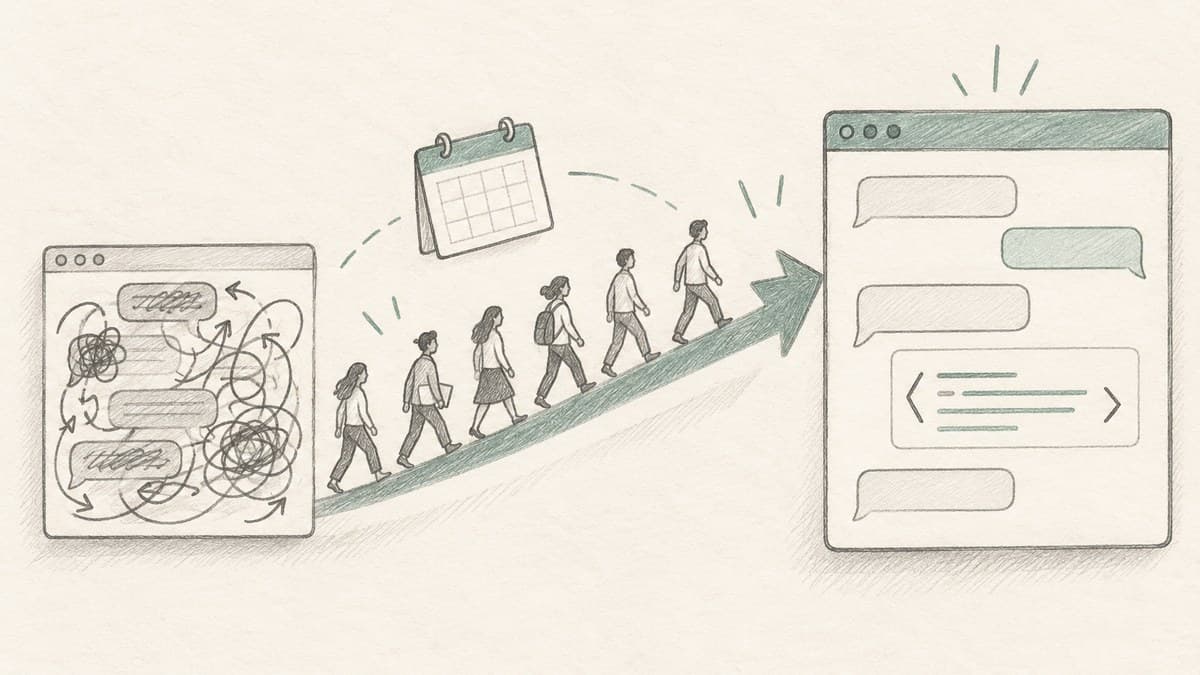
It worked for sending messages. It didn't work for engineers.
This is how we moved the whole company to a self-hosted chat of our own in about a month, and what I'd do the same way again.
What was wrong
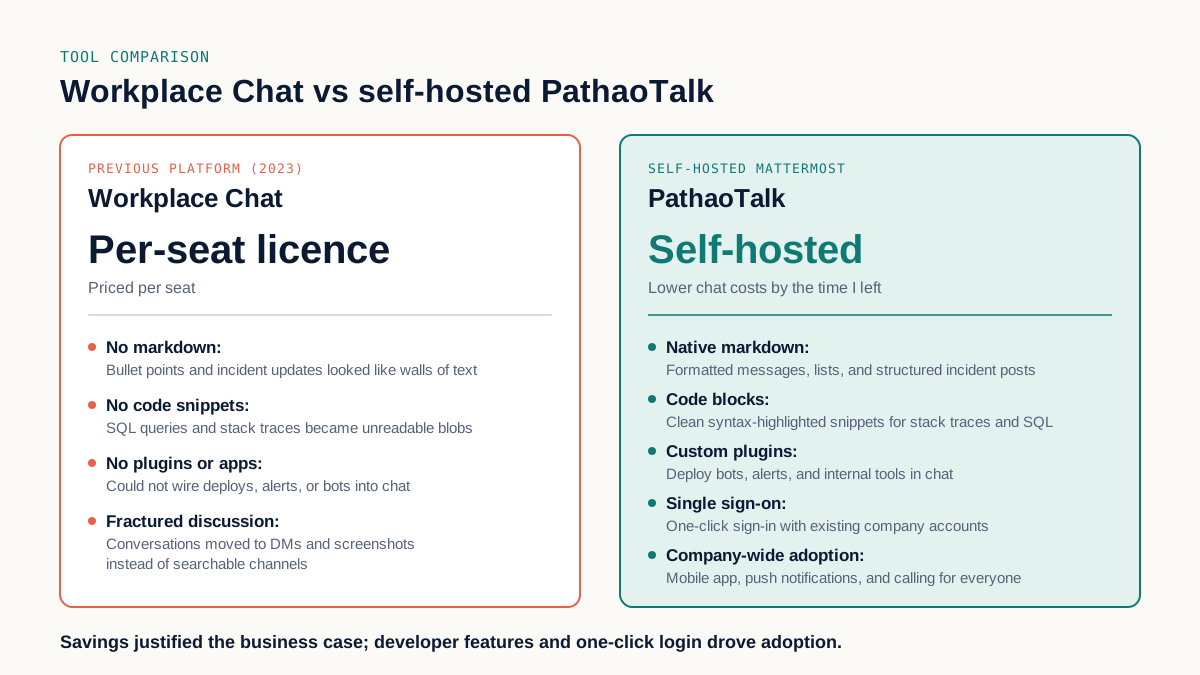
- No markdown. You couldn't format anything. A bulleted incident update looked the same as a wall of text.
- No code snippets. Engineers pasted stack traces and SQL into chat all day, and they came out as unreadable blobs.
- No plugins or apps. We couldn't wire deploys, alerts or bots into the place where people were already talking.
- It charged per seat for every person in the company.
Developers didn't enjoy using it, and you could feel it. Conversations drifted into DMs and screenshots instead of channels people could search later.
| Feature | Workplace Chat | PathaoTalk (Mattermost) |
|---|---|---|
| Monthly Cost | Per-seat licence | Self-hosted infrastructure |
| Markdown & Code | Unsupported (plain text blobs) | Full syntax highlighting & fenced code blocks |
| Integrations | Limited integrations | Open REST API, custom bots & CI/CD alerts |
| Data Control | Hosted on Meta servers | Self-hosted database with full retention ownership |
The proposal I wasn't sure about
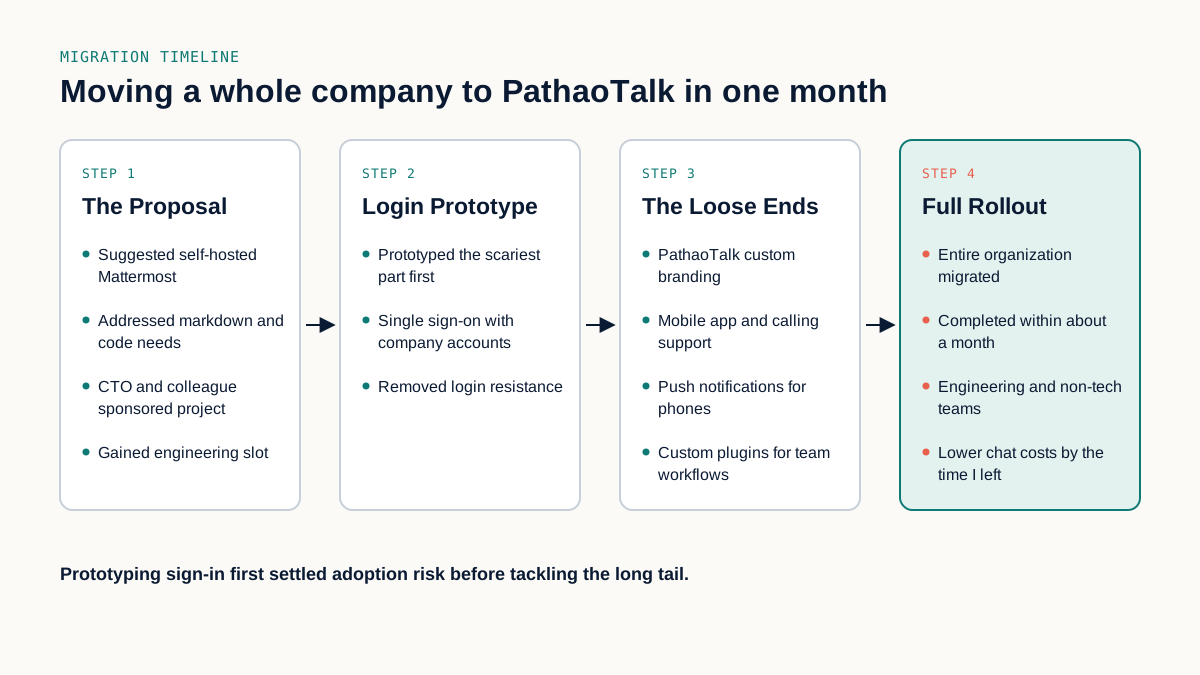
I suggested we move to Mattermost, self-hosted. It has markdown, code blocks, a plugin system and a real API. On paper, it fixed every complaint.
I was honest that I wasn't confident we could pull it off. Chat is the one tool every person in the company uses every day. If the replacement is worse, even for a week, everyone notices.
So the idea sat for a while. Then our CTO and one of my colleagues got interested and pushed it again. With one engineer behind it, the idea stayed an idea. With the CTO behind it, it got a slot.
The prototype that settled it
The first real question was login. Nobody was going to accept another password.
My colleague got single sign-on with company accounts working in a quick prototype, so people could use the accounts they already had.
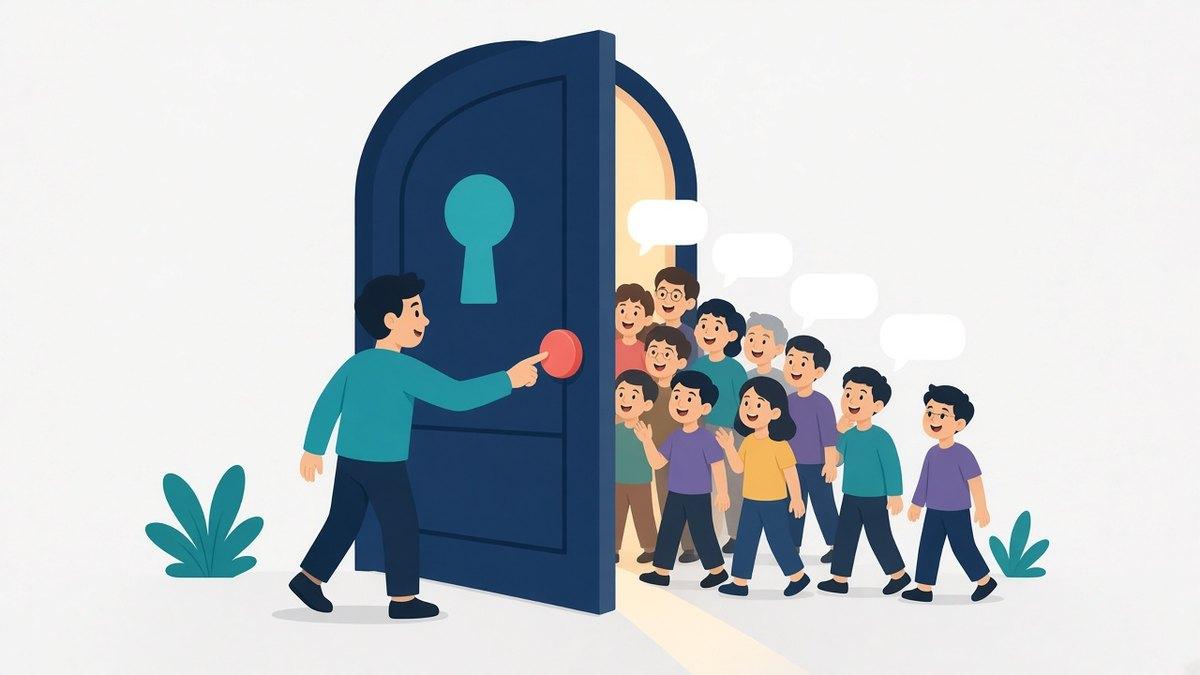
It worked. Once people could log in with one click, the project stopped being "should we" and became "what's left".
Closing the loose ends
What was left was a long list of small things. Any one of them could have killed adoption on its own:
- Sign-in: making it ready for the whole company.
- Branding: we called it PathaoTalk. It looked like ours, not like a tool someone installed.
- Plugins and our own customizations for how Pathao teams actually worked.
- Push notifications, because a chat app that doesn't buzz your phone isn't a chat app.
- Calling.
- The mobile app.
None of these were hard alone. Together, they were the difference between "the engineers' chat" and "the company's chat".
A month later
Within about a month, 100% of the company had moved to PathaoTalk. Not only engineering: everyone.
By the time I left, it had cut what Pathao spent on company chat.
Lessons I took from it
- Fix the complaint people feel every day. Nobody moved because of the invoice. They moved because code blocks and formatting made their day better. The savings were the business case; the features were the adoption plan.
- Prototype the scariest part first. Login was the riskiest piece. Once single sign-on worked, everything else was just work.
- A proposal needs a sponsor. I had the idea and the doubts. The CTO's push turned it into a project with time and attention.
- Adoption is the long tail. Push notifications, branding and the mobile app are dull engineering, and they're what makes people stay.
If you're paying per seat for a chat tool your engineers don't like, a self-hosted Mattermost is worth a weekend prototype. Start with login.
Frequently asked questions
- How do you replace Facebook Workplace Chat with Mattermost?
- Self-host Mattermost, prototype login first, then close the loose ends. At Pathao we prototyped sign-in with company accounts, then added branding, plugins, push notifications, calling and a mobile app. The whole company moved in about a month.
- Why did Pathao move off Workplace Chat?
- Workplace Chat had no markdown, no code snippets and no plugins or apps, and it was priced per seat. Engineers could not format incident updates or paste stack traces readably, so conversations drifted into DMs and screenshots.
- Does self-hosting Mattermost save money?
- It can. At Pathao, moving from per-seat Workplace Chat to self-hosted Mattermost, called PathaoTalk, cut our communication costs by the time I left.
Related posts
- Pathao Tickets: replacing Zendesk with a patched open source helpdesk
Pathao support ran on Zendesk. We patched an open source helpdesk for ticketing, live chat and automations at roughly a third of the Zendesk bill.
- Self-hosting CodiMD with company sign-in so engineers kept using it
Pathao engineers already liked a hosted markdown editor. I self-hosted the open-source CodiMD behind company sign-in, and the whole company moved to it.
- Tailscale and Cloudflare Tunnel: my home PC with zero open ports
How I reach my home PC: Tailscale for ssh and Herdr from my own devices, Cloudflare Tunnel with Access for browser tools, and no open router ports.