- Published on
The industrialization of code: software development trends for 2026
- Authors

- Name
- Nadim Tuhin
- @nadimtuhin
On this page
Six months ago, I was mass-applying to jobs, convinced AI would replace me. Today I'm shipping faster than ever and more confident in my career trajectory than I've been in years.
What changed was my mental model. Once I stopped seeing AI as a replacement and started seeing it as industrialization, everything clicked.
TL;DR: my 2026 strategy
| Area | Old approach | New approach |
|---|---|---|
| Coding | Write everything manually | AI for boilerplate, manual for architecture |
| Learning | Specialize deeply in one stack | Generalize broadly + depth where it matters |
| Tools | One IDE, one language | Claude Code + Cursor + multiple languages |
| Value prop | Lines of code written | System understanding + judgment calls |
The rest of this article explains why this shift matters and what I'm doing about it.
AI: from skepticism to cautious realism
One of the more significant shifts I've noticed is the move from pessimism to cautious realism about AI-generated code. This isn't another hype piece; I have concrete reasons for this view.
DHH publicly acknowledged that while he still loves writing code by hand, modern AI coding tools have moved from toys to genuinely useful. Coming from someone who has built successful software products, that's worth noting.
Even more telling is Linus Torvalds's position. The creator of Linux, famously skeptical and allergic to marketing nonsense, has acknowledged that AI models are now genuinely useful for development tasks. When someone like Torvalds, with decades of experience at the highest levels of software development and no financial stake in AI, adjusts his stance, that's worth paying attention to.
Industrial software: a new paradigm
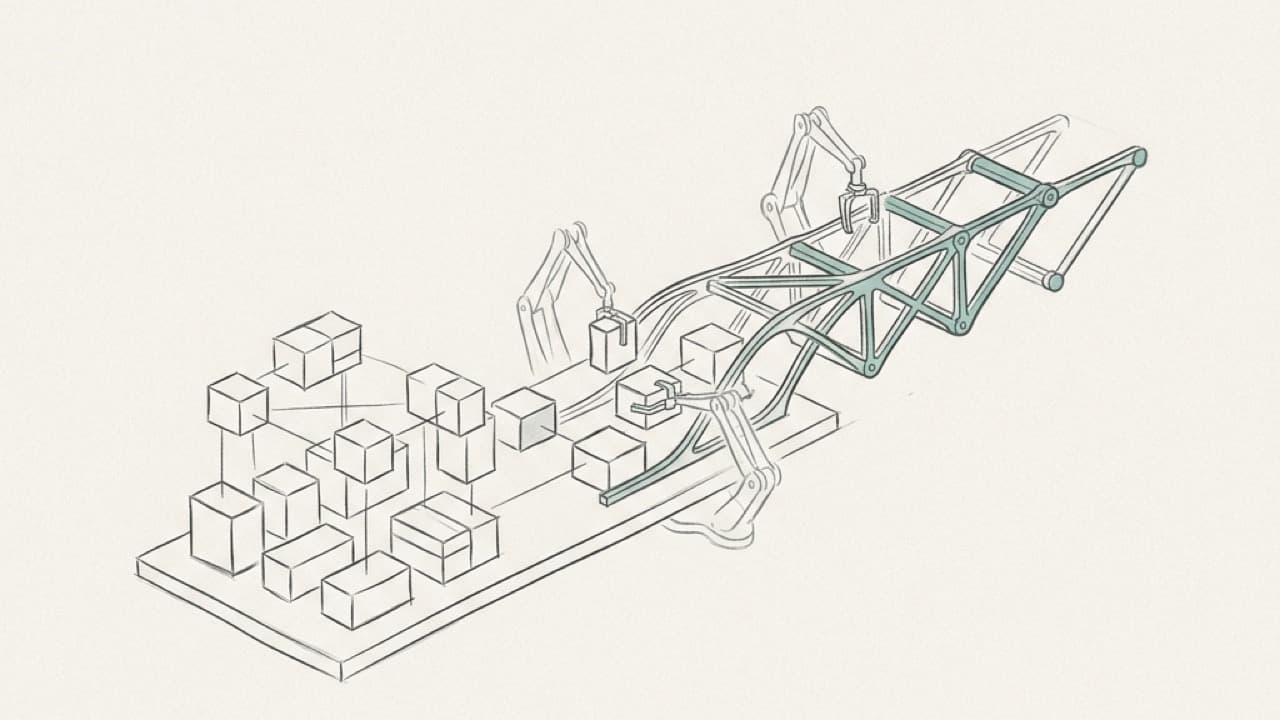
The framing of "industrial software" is a useful lens for understanding what's happening now. The core insight: AI-generated code is the industrialization of software development.
Think about the difference between a handmade painting, where the artist spent months on every brushstroke, and a printed poster. The poster isn't art, but it scales infinitely easier. Or compare a mechanical watch full of complications costing thousands of dollars with a quartz watch costing a few dollars that keeps better time. One is craftsmanship for its own sake; the other is industrial efficiency.
Software is drifting toward the quartz watch model, whether we like it or not. For most of software's history, complexity was inherent. You needed time, skill, and experience. Code was expensive because people were expensive, and people were the bottleneck. AI breaks this by making production cheaper, faster, and increasingly disconnected from human expertise.
Once production detaches from skill, you don't get better code; you get more code. Notice that articles hyping AI focus on quantity, not quality, because nobody cares about quality in an industrial revolution.
When any industry undergoes industrialization, the immediate effect is almost never better craftsmanship or long-term reliability. It's a sharp increase in volume. The moment barriers to production fall, labor is partially removed from the equation, specialized skills stop being the primary constraint, and output accelerates faster than the surrounding ecosystem can absorb.
Once production becomes cheap enough, the system optimizes for quantity over quality. This pattern repeats across industries, from publishing to food production. None of these advances were created with bad intentions, but economic pressure consistently bends mass production toward high volume, low durability, and low individual value.
When people argue that AI isn't good enough to produce reliable code, they might be right, but it doesn't matter because the rules of the game have changed. The economic reality is that low-quality mass-produced software will often be good enough to win, just as a cheap plastic toy is more profitable for the manufacturer than a handcrafted wooden one that takes weeks to make.
The 90% iceberg: what AI cannot replace
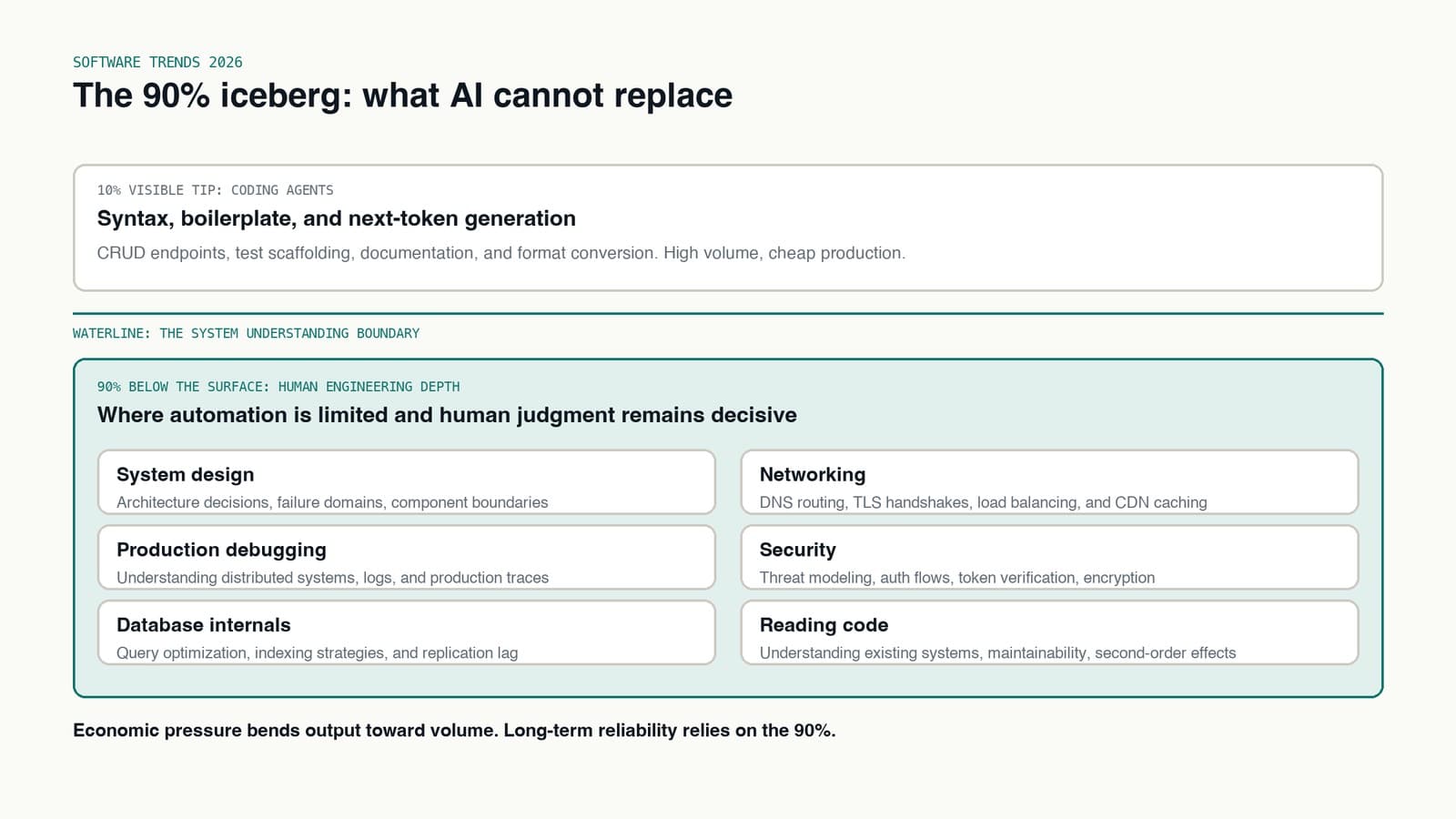
Adapting to coding agents is the easy 10%. What differentiates a valuable software developer from a "vibe coder button pusher" is the other 90%: the boring stuff that doesn't get likes, views, or VC money.
That means knowledge and experience. In any industrialized process, there are still chokepoints where automation is limited and humans remain the decisive factor. Factories still need engineers; mass food production still needs nutritionists, safety regulators, and people who understand supply chains. Even the most automated systems rely on a small group of people who actually understand how everything fits together, where it breaks, and what the second and third-order effects look like when something goes wrong.
Software is no different. AI can generate code well, but it doesn't understand it beyond the probability of the next token. That limitation matters.
The generalist imperative
My priority for 2026 is to keep learning, master the basics, and become a true software developer generalist. There's been a lot of talk about "full stack fatigue," but this is where I think the most value gets created.
The "specialization is for insects" philosophy applies here: a developer who understands multiple layers of the stack will be more valuable than one who only knows a single framework deeply.
In 2026, I'll keep documenting my process of learning new languages, frameworks, and software concepts. More programming languages, more runtime internals, more databases, more operating systems, more boring fundamentals that compound over time. Learning new things is enjoyable, but understanding how different layers fit together is the only reliable way to keep moving forward.
Reflections
The balanced view here matters: neither pure hype nor pure doom. The industrial software framing gives a useful lens for what's happening.
That said, counterpoints exist. Does industrialization necessarily mean lower quality? Open-source peer review suggests quality can scale. Is the "90% iceberg" immune to AI? The line between "generating code" and "understanding systems" is blurring. And the impact on developer well-being in an industrialized landscape deserves more attention.
My current setup
Here's what I'm using in 2026:
AI coding tools:
- Claude Code: My primary agent for complex refactoring and multi-file changes
- Cursor: Daily driver IDE with inline completions
- GPT-4o-mini via API: Cheap option for repetitive tasks (~$3/month)
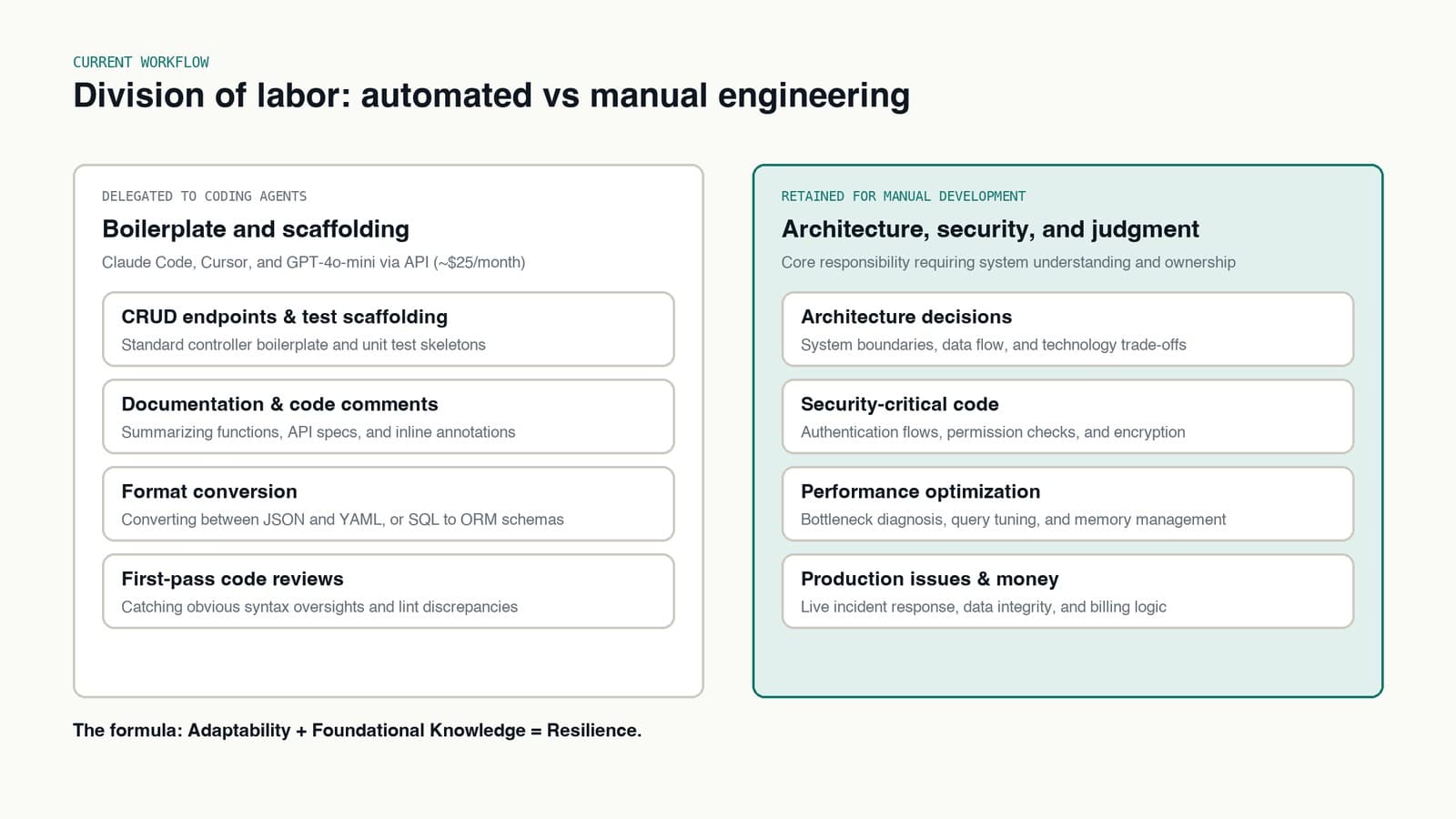
What I let AI do:
- Boilerplate (CRUD endpoints, test scaffolding, config files)
- Documentation and comments
- Converting between formats (JSON ↔ YAML, SQL ↔ ORM)
- First-pass code reviews
What I do manually:
- Architecture decisions
- Security-critical code
- Performance optimization
- Debugging production issues
- Code that touches money or user data
Monthly cost: ~$25 total (Claude Pro + Cursor Pro + API usage)
Skills I'm doubling down on
These are the "90% iceberg" skills that compound over time:
| Skill | Why it matters |
|---|---|
| System design | AI can't architect; it can only implement |
| Debugging production | Understanding distributed systems, logs, traces |
| Database internals | Query optimization, indexing, replication |
| Networking | DNS, TLS, load balancing, CDNs |
| Security | Threat modeling, auth flows, encryption |
| Reading code | Most work is understanding, not writing |
My 2026 learning list:
- Deep dive into PostgreSQL internals
- Learn Rust (systems thinking, memory model)
- Container orchestration beyond
kubectl apply - Observability stack (OpenTelemetry, Grafana, traces)
Final thoughts
The key shift for 2026 is understanding AI's role in industrialized software, without embracing it uncritically or rejecting it entirely.
The formula: Adaptability + Foundational Knowledge = Resilience
The most successful developers will take a dual approach: use coding agents while deepening their generalist skills. Use the tools, but don't become the tool. Build on foundations that compound over time, not just the latest framework.
Specialization is for insects. Stay broad: understand the whole system, and learn to build, maintain, and evolve software that works, not just to generate code.
What's your strategy for 2026? I'd be curious to hear how you're adapting.
Resources
- Claude Code: Anthropic's AI coding agent
- Cursor: AI-first IDE
- The Pragmatic Programmer: Timeless fundamentals